The Dark Pools of Award Travel: How Airlines Run a Shadow Inventory You’ll Never See… Unless You Outsmart Them
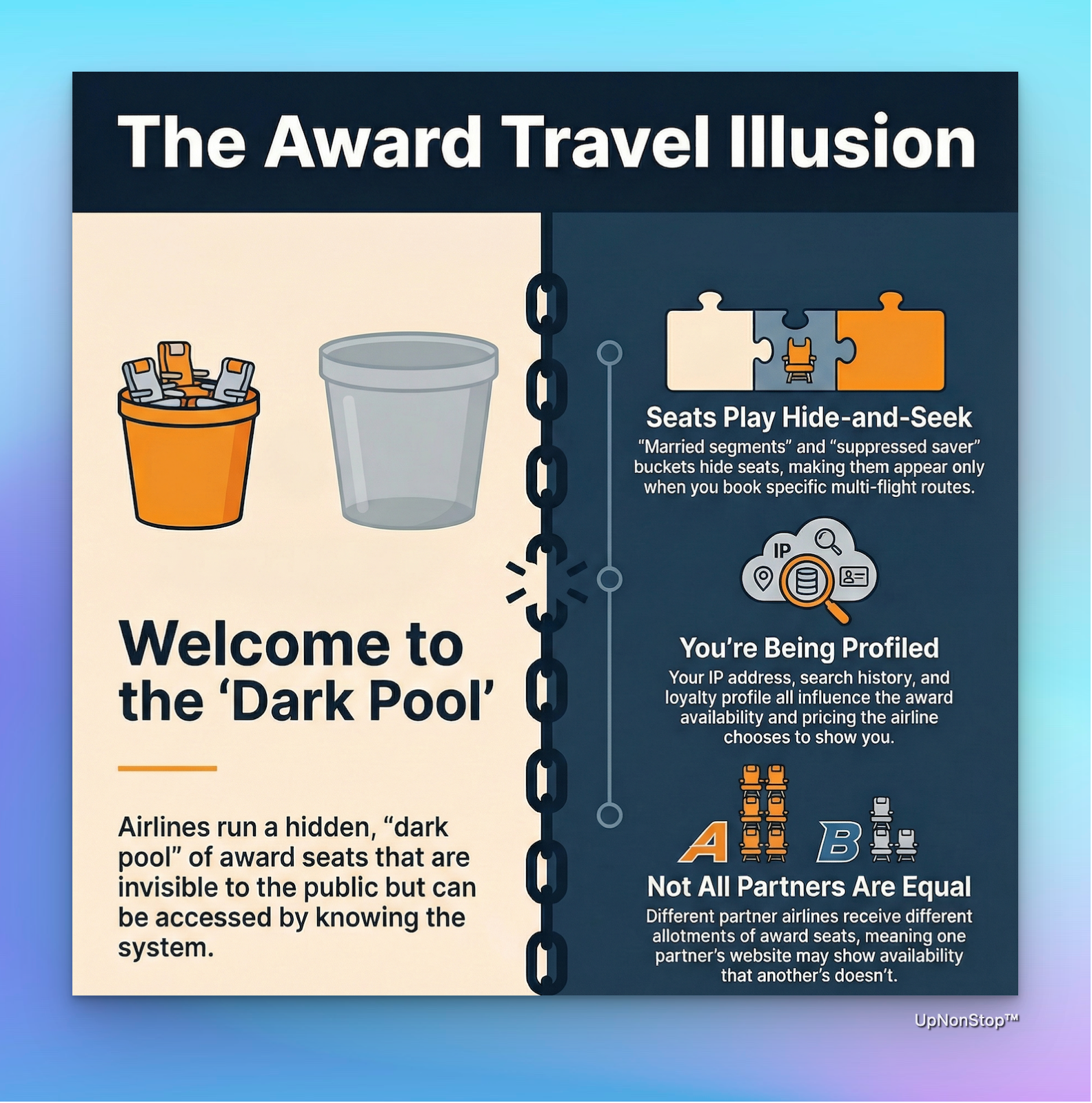
Airlines run “dark pools” of award space - hidden buckets, married segments, regional suppression, partner-only seats, and behavior-based visibility the public never sees. Businesses with optimized earn strategy unlock these shadow inventories and book seats airlines swear don’t exist.

If You Only Had 60 Seconds to Read This Article
| Click Here 🤏🏻
Airlines show you a curated illusion of award space, not the real inventory. Saver seats, partner access, and premium cabins often exist behind hidden buckets, married segments, and regional filters designed to push consumers toward cash fares or inflated points prices.
Award availability isn’t fixed; it’s behavior-based. Your search patterns, loyalty profile, IP location, and earn strategy all influence what airlines choose to reveal. Most travelers train the system to hide saver space without realizing it.
Business owners can break into the “dark pools” because high, predictable spend signals value. With the right earn mix, partner mapping, and timing windows, companies unlock premium seats that never appear for casual travelers - even though they exist in the system.
The scarcity narrative is manufactured. The seats are there. The trick is knowing where airlines hide them, when they release them, and which partners expose them.
We built UpNonStop to navigate these shadow layers and surface the seats everyone else thinks are impossible.
Everything else you need to know is just below 👇🏻
🎞️: Powered by NotebookLM @ UpNonStop
Airlines love to talk transparency.
They love telling you availability is “dynamic,” “real-time,” and “based on demand.”
They also love sending you those friendly emails claiming “more award seats than ever.”
Cute.
If only any of it were true.
The reality?
Award travel today operates on 2 layers:
- The publicly visible layer: the seats you and every other human sees.
- The hidden, behavior-sensitive, channel-specific layer: the seats airlines quietly hold back, release unpredictably, or surface only to certain partners, markets, or earning patterns.
In finance, these murky, less-regulated structures are called dark pools - private exchanges where trades happen outside public view.
In award travel, the same idea applies.
Except here, the “trades” are seats, and the “participants” are loyalty programs, partner airlines, distribution algorithms, and unsuspecting travelers who think they’re seeing everything when they’re seeing… almost nothing.
This piece exposes the dark pools of award travel - the hidden buckets, the suppressed inventory logic, the human-designed incentives that reward certain behaviors, and the exact ways businesses can break into these pools and book seats the average consumer never sees.
This is not a conspiracy theory.
This is just the part the loyalty programs don’t advertise.
Let’s get digging ...
The Award Travel Illusion Machine
Award travel was never meant to be fair.
It was built as a yield management tool (not a customer perk) and airlines have refined the system to maximize:
- Cash yield
- Co-branded credit card profitability
- Partner reimbursement revenue
- Breakage (points earned that are never redeemed)
Everything - from what you see online to what’s “available” on one site and not another - is designed to push you into behaviors that benefit the airline financially.
And yet, almost nobody realizes they’re operating inside a curated visibility bubble.
Most people assume:
- “If it’s not showing, it’s not available.”
- “If it’s 350,000 miles, that means demand is high.”
- “Partner inventory should match the operating carrier.”
- “Dynamic pricing reflects real-time load factors.”
All wrong.
Let’s dismantle each layer.
II. Hidden Buckets: The Seats That Exist But Are Invisible
Airlines have multiple award inventory buckets.
Here are the three they will never put on the homepage:
Bucket 1: “Suppressed Saver” Inventory
Seats that technically exist at saver levels but aren’t surfaced unless:
- You search from a certain country
- Through a partner
- Using specific routing
- With a multi-city configuration
- Or during a specific time window (literally a few minutes per day)
These seats exist in the GDS.
But the airline website will pretend they don’t.
Bucket 2: “Married Segment” Seats
A seat is available only if you book two segments together.
Example:
There’s saver space from FRA → JFK on Lufthansa, but Lufthansa will not release it to partner airlines unless you book ATH → FRA → JFK as a married pair.
Break the marriage → space disappears.
Put it back → space magically reappears.
This is how airlines force suboptimal routings and extract more partner reimbursements.
Bucket 3: “Controlled Release” Inventory
Some airlines release seats in behavioral patterns - based on:
- Day of week
- Time of day
- 14-, 7-, 3-, and 1-day load factor sweeps
- Partner request throttling
- “Demand modeling” (translation: corporate travel trends)
If you don’t know the timing patterns, you never see these seats.
UpNonStop sees them.
Because we know the patterns.
Shadow Partners: Why Some Sites Show More Than Others
Most travelers think all partners see the same award seats.
Here’s the truth:
Partners receive different allotments, different timing, and different visibility triggers.
Examples:
- Avianca LifeMiles often shows seats United doesn’t want to show its own members.
- Asia Miles sees partner Cathay space before others do.
- Qantas sometimes shows Emirates and Qatar premium space days before anyone else.
- Turkish occasionally reveals United seats that United.com hides behind “dynamic” pricing.
This is intentional.
It’s how airlines manage partner reimbursement costs while still satisfying partnership obligations.
Meaning:
There is no such thing as “one source of truth.”
There are multiple truths layered on top of each other.
Your job is not to search one site.
Your job is to map visibility patterns across sites - and understand which partners are privileged for which carriers at which times.
This alone opens award space 90% of travelers think doesn’t exist.
Regional Bias: Same Search, Different Results
Your IP address, loyalty profile, and even your historical behavior can change what you see.
Yes, seriously.
Airlines have built systems that:
- Prioritize certain markets
- Protect others
- Or penalize “known deal-seekers”
This is why:
- The U.S. version of a site shows nothing
- But the German or Singaporean version shows saver space
Or why:
- Searching JFK → CDG returns 270K+
- But searching CDG → JFK returns saver-level pricing
Or why:
- One browser/device consistently sees worse inventory than another
It’s not your imagination.
It’s regional segmentation layered onto revenue management.
Dark pool behavior.
Behavior-Based Visibility: You’re Being Profiled
Airlines and loyalty programs quietly run behavior modeling:
- If you often redeem on premium cabins → they show you less saver space
- If you carry large unused balances → they show you inflated pricing
- If you search repeatedly → prices jump
- If you use co-branded cards → you get different redemption pressures
- If you have business-level spending → you often get better patterns (but only if your earn strategy is optimized)
Airlines won’t admit this publicly.
But internal economists openly discuss “redemption behavior shaping.”
Translation:
Your past choices affect what you see today.
So yes - if you’ve been redeeming poorly, you’ve been training the machine to mistreat you.
UpNonStop retrains it.
Phantom Space: The Ghost Inventory That Disappears When You Click
Every award traveler knows this:
You see a seat.
You click.
Gone.
Why?
Because that seat was:
- Advertised but not actually bookable
- Temporarily blocked during your session
- In a queue awaiting partner confirmation
- Or intentionally surfaced as a “pressure tactic” (yes, really)
Phantom space occurs because airlines:
- Surface inventory before verifying partner access
- Fail to sync availability after load factor changes
- Delay updates between GDS and award engines
- Use “soft hold” reservation logic that times out poorly
Example:
United’s infamous “ghost Lufthansa First” phenomenon.
Or Air Canada Aeroplan’s tendency to show phantom ANA premium space during peak hours.
Again: dark pool behavior.
It exists in one system but not another.
Award Space That Only Businesses Can Trigger
Here’s where the UpNonStop thesis becomes unavoidable:
Businesses unlock visibility patterns individuals never get.
Why?
- Your annual spend creates a loyalty profile airlines prioritize
- Your earn mix signals “high value”
- Your behavior resembles corporate travel
- You sometimes get suppressed saver space that individuals never trigger
Most business owners have no idea this hidden benefit exists.
But:
- Spend $100K-$3M a year
- Distribute across multiple issuers
- Optimize earning with the correct ratios
- Maintain predictable monthly patterns
…and the algorithms start giving you corporate-traveler-level availability - even when you’re not flying on a corporate agreement.
This is where First Officer earns its keep.
This is also why UpNonStop regularly finds seats nobody else sees.
Because you’re not just another user.
You’re a revenue signal.
Airlines respond to revenue signals.
The Most Aggressive Dark Pool Tactics by Carrier (A Short List)
Lufthansa Group
- Married segment manipulation
- Partner throttling
- Short-haul add-on tricks
- “Invisible” first class until 14 days or less
- Phantom external partner space
United
- Dynamic pricing that masks true saver space
- Acclimation profiling (repeat search penalty)
- Differential partner availability
- IP-based visibility quirks
Delta (the king of dark pools)
- Market-based pricing that shifts within minutes
- Regional suppression
- Zero transparency partner logic
- “Shadow saver” seats that only surface via partners
- Calendar availability distortion
American
- Web vs. mobile app discrepancies
- Married segment quirks in alliance bookings
- Short-haul partner unlocks long-haul hidden seats
- Buy-miles promotions tied to availability windows
Air Canada
- Partner sync delays
- Phantom ANA/JAL space
- Behavior-based repricing
- Programmatic throttling when transfer volume spikes
The patterns differ.
The principle is the same:
You never see the full picture.
How to Break Into the Dark Pools (The UpNonStop Method)
Here’s where theory becomes practice.
To consistently access shadow inventory, you need to build a structure of search, timing, earning, and routing that aligns with how airlines actually distribute seats - not how they claim to.
Step 1: Multi-Partner, Multi-Market Search Mapping
Never search just one site.
Never search just one direction.
Never trust official results.
For most long-haul bookings:
You need 8-12 partner checks per route.
Step 2: Time-of-Day Release Windows
Most airlines update:
- 00:00-01:00 local headquarters time
- 04:00-05:00
- 11:00-13:00
- 21:00-22:00
If you’re not mapping these windows, you’re missing seats.
Step 3: Reverse Routing Logic
If JFK → CDG shows no space
Search: CDG → JFK
Then: CDG → North America → JFK
Then: origin → major hub → destination
Then: origin → nearby hub → destination
Award engines are simple.
Airline routing rules aren’t.
Step 4: Married Segment Breaking
You manually construct:
- A → B → C
then - B → C
- A → B
Until you reveal saver inventory hiding in the chained segments.
Step 5: Earn Strategy That Triggers Better Availability
This is the part nobody talks about.
When an SMB runs a balanced, optimized earn strategy, they send positive revenue signals to issuers and airlines:
- Predictable
- High volume
- Mixed category
- Multi-program
- Transfer-friendly
This classifies you as “high-value, low-risk,” and the algorithms behave differently.
This is why some “random plumber in Ohio” (your archetype) gets more availability than a seasoned points blogger with 20 cards.
Step 6: Use Transfer Timing to Force Syncs
Transferring small amounts at specific times occasionally forces programs to update their partner availability.
Not always.
But often enough that it matters.
The Greatest Lie: “There Are No Award Seats Left”
Whenever you see 300K+ pricing, understand this:
- That’s not demand.
- That’s punishment.
- That’s the airline telling you your strategy isn’t optimized.
Airlines do NOT run full flights.
They just run full visibility.
Two very different things.
Award seats exist far more often than you think - but they live:
- Under different routes
- Under partner systems
- Under timing windows
- Under married segments
- Under suppressed buckets
- Under behavioral profiles
- Under regional visibility rules
If you don’t know where these shadow pools are, you never see them.
But they’re there.
Every day.
Why UpNonStop Exists
Because Small & Medium Business owners deserve access to the seat that:
- Exists 💡 (Duh...)
- Is bookable 💻
- But is buried under layers of intentional opacity 🪦
Banks don’t teach this;
Airlines don't want to;
Award blogs don’t know how;
Point.me doesn’t cover earn strategy;
Travel agencies don’t optimize routing logic;
And corporate travel platforms are incentivized to keep you cash-paying.
So UpNonStop does the opposite.
We blow the whole system open.
We teach business owners how to build precision earn strategies that unlock shadow inventory and book seats the average traveler will never know existed; and then we execute it for them.
This is the point.
This is the power.
This is the edge.
Final Approach
The award travel world is not a level playing field.
It’s a multi-layered visibility maze - part algorithm, part economics, part psychology, part behavior modeling, and part corporate revenue strategy.
But once you understand the dark pools (and learn to play inside them) you stop overpaying. You stop getting blocked. You stop seeing “no availability.” You stop settling for bad routings. You stop being manipulated by inflated pricing.
You start flying like someone who knows the code.
Because you do.
And once business owners understand this system, the entire world of travel opens up - reliably, repeatably, profitably.
That’s the UpNonStop difference.